
How Bylaw and Order works
Bylaw and Order is not a search box over a pile of PDFs. It is a rules engine that holds a sport's written rules in the hierarchy they are actually written in, reads them in full for every question, and refuses to answer without showing the wording it relied on.
Layered rulebooks, in the right order
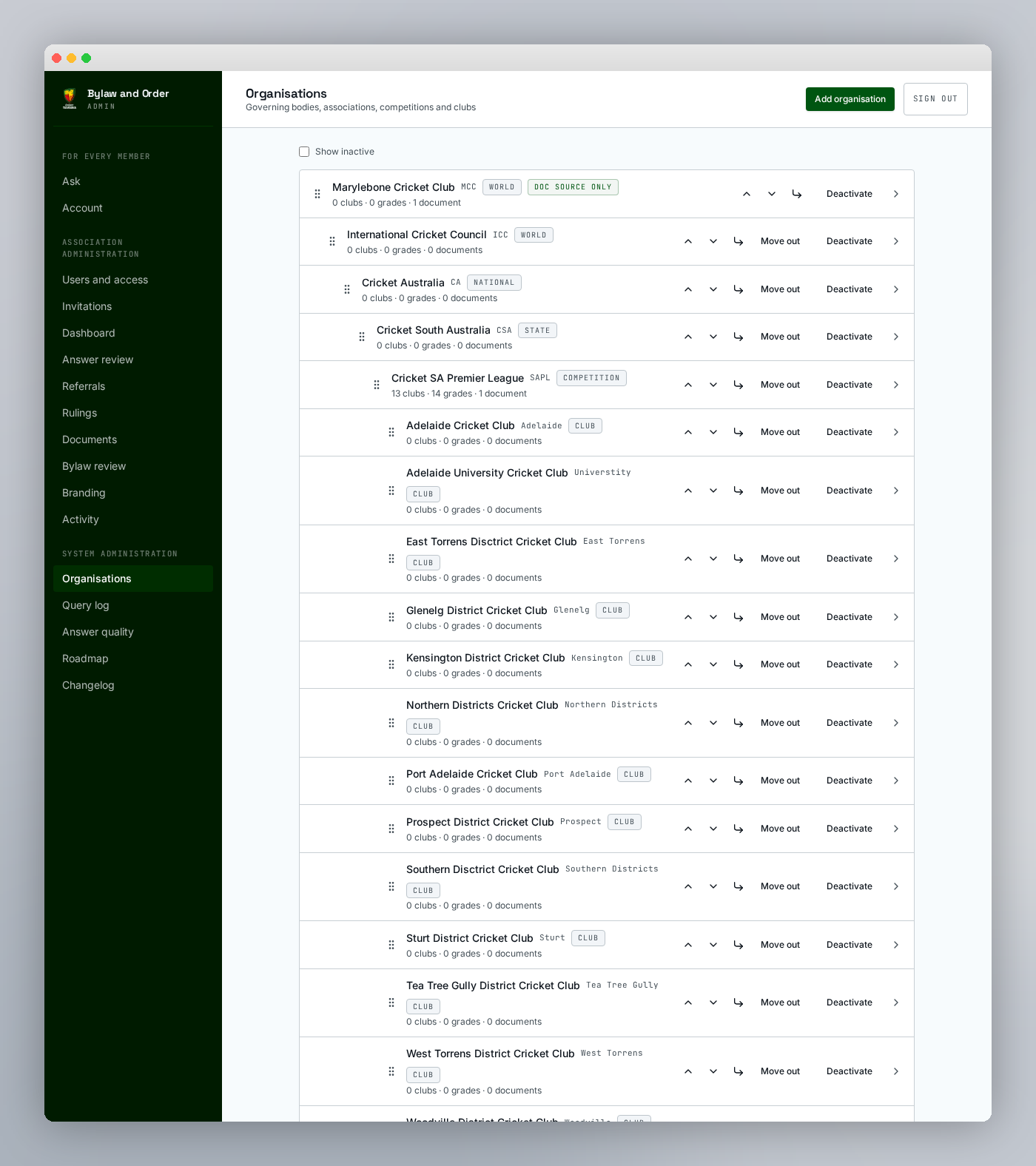
Documents are held in the structure the sport actually uses: the governing body's laws, then the competition's by-laws and conditions, then anything local. An answer for a club sees everything above it, and knows which layer takes precedence.
Versioned editions
Every document has an edition and a period in which it is in force. Only one edition can be current at a time, so an answer can never quietly quote last season's rule.
Answers that cite themselves
Each answer leads with the bottom line, then shows the reasoning and the source quotes as separate, bounded citations. If the rulebooks do not settle the question, the answer says so rather than guessing.
Escalation to a binding ruling
Any answer can be referred to the association with one tap, or flagged as wrong. Administrators see the queue, issue a ruling, and the person who asked is notified by email and in the app. Rulings can be corrected or withdrawn, with the history kept.
Automated by-law review
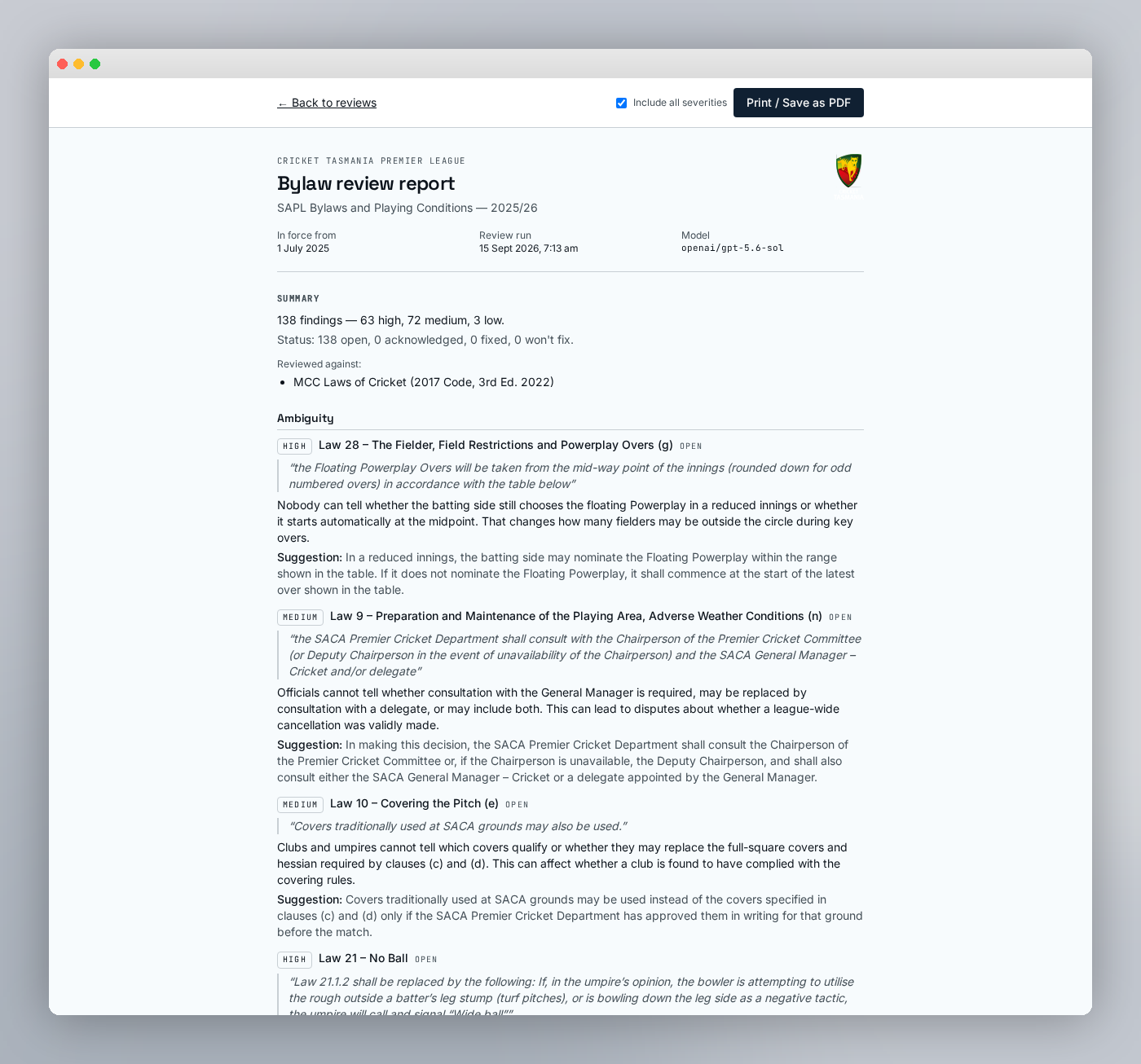
Point it at a rulebook and it reports parent conflicts, internal conflicts, gaps, ambiguity and clarity problems — with the quoted wording for each finding. A separate proofread pass covers spelling, grammar and clause numbering. Severity follows consequence, not style: high where a defect could change a result or eligibility, medium where it causes disputes, low where it is cosmetic.
Set-up from the documents themselves
A competition's structure — its grades, formats and entrants — can be proposed straight from its own by-laws, so onboarding a new competition does not start with weeks of data entry.
Whole rulebook, not fragments
A by-law clause depends on its definitions, exceptions and cross-references, which is exactly what fragment-and-retrieve systems can drop. Bylaw and Order reads the full corpus in force for the question so the deciding clause is never missed.
Governance and audit
Access is invite-only and scoped by role: system administrators, association administrators and club administrators each see their own part of the structure. The audit log keeps an unalterable record of document changes, reviews and rulings.
A loop, not a search box
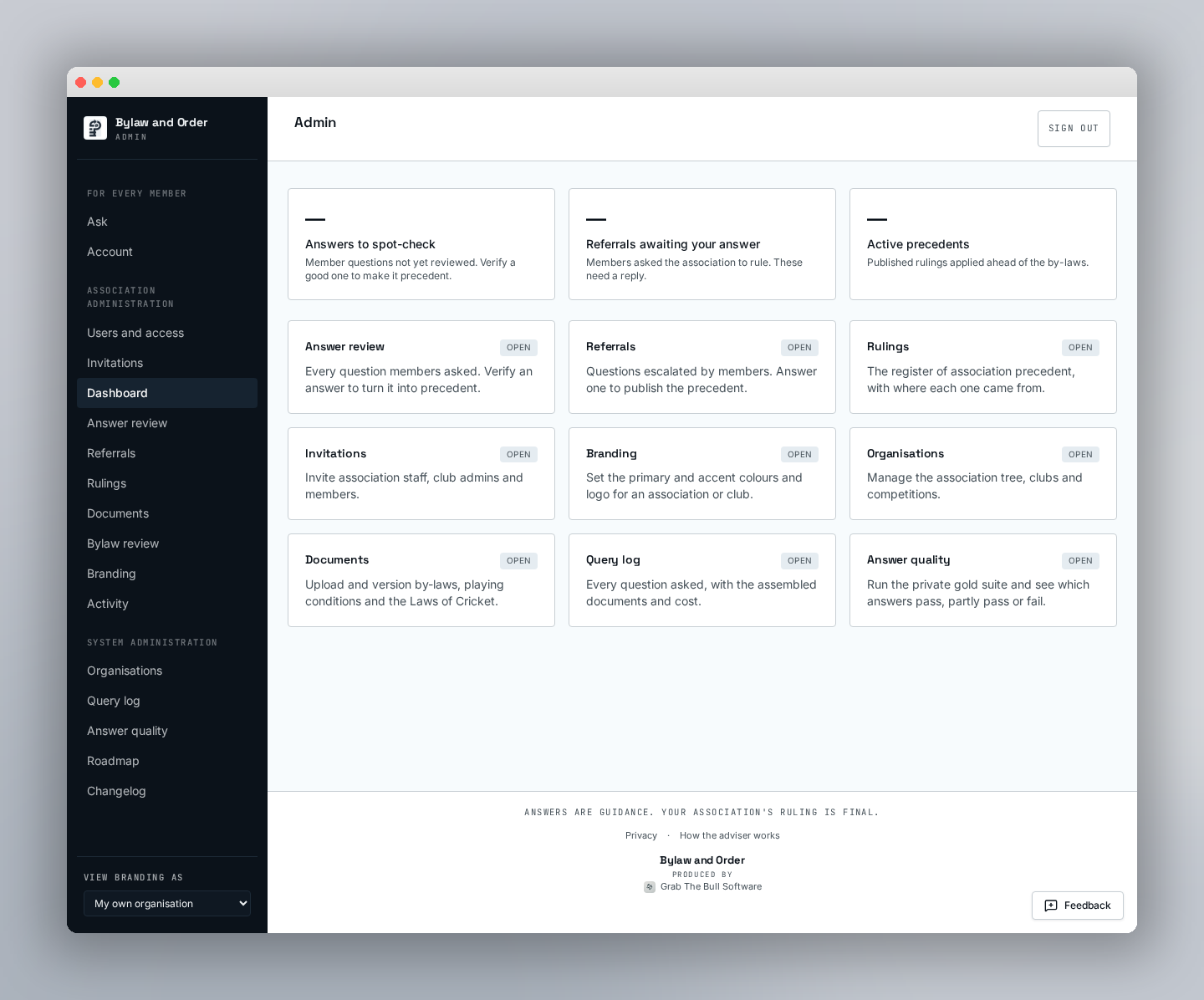
A member asks a question. The system answers from the documents in force. The association can review, reject or publish that answer as a binding precedent. Once published, the ruling outranks the model's own reading of the documents, and future answers must say so. Where the documents are silent, the system refers the question rather than guessing.
Guidance, not a substitute for the association
Answers are guidance. The association's ruling is final, and the product is built to make that path short rather than to pretend it isn't needed. There is a fuller explanation of the adviser's limits on how the adviser works.